
I. Pre-Production Inspection by Shift Supervisor
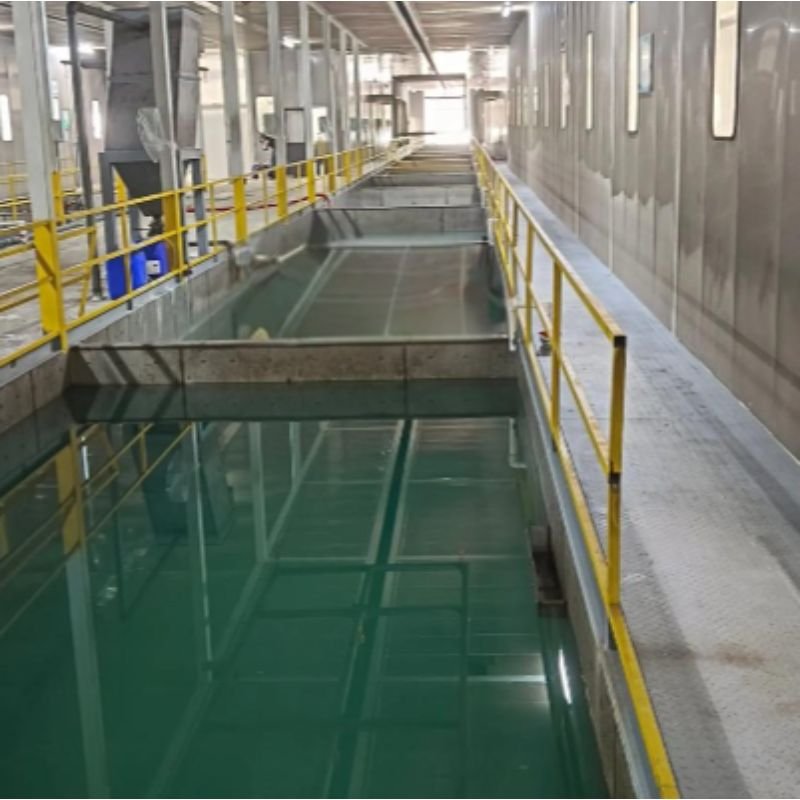
Before production begins, the shift supervisor must inspect the E-coating line as follows:
- Check all pipelines for paint or water leaks. Address any leaks immediately. If unresolved, promptly contact maintenance personnel.
- Monitor anolyte conductivity: Ensure it is within 500-800 µS/cm. If exceeded, drain an appropriate amount of anolyte from the anolyte tank below the electrocoat tank, then add deionized (DI) water until conductivity is around 650 µS/cm.
- Check paint temperature on the heat exchanger display panel. The optimal range is 30°C ± 2°C. Initiate cooling if temperature exceeds 32°C or heating if below 26°C.
- Verify normal operation of the DI water system. Troubleshoot abnormalities if possible; otherwise, contact maintenance immediately.
- Inspect main circulation bag filter pressure. Replace the filter bag (50µm) if pressure exceeds 0.4 MPa.
- Ensure proper operation of the ultrafiltration (UF) system. Troubleshoot as needed or contact maintenance. UF filter pressure should be ≤ 0.2 MPa.
- Check paint level: The auxiliary tank level should be approximately 3 cm lower than the main tank to create a differential, preventing foam (generated by UF2 spray water entering the auxiliary tank) from flowing into the main tank. If the level is too low, add DI water via the auxiliary tank valve (with personnel monitoring throughout).
- Inspect the purification treatment unit for water or oil leaks and address promptly.
- Check levels in the clean water, DI water 1, and DI water 2 tanks to prevent pump dry running and damage. Monitor water quality to avoid contaminants entering the electrocoat tank, which affects paint quality and service life. Replace water in the clean water tank every 2 days; replace DI water as needed.
- Add paint components as per the technical department’s notification: replenish color paste and emulsion (theoretical ratio 1:4) via the diaphragm pump below the electrocoat tank. Add additives every 3 days (0.5 drum/25 kg) or every 7 days (1 drum/50 kg), pouring slowly into the auxiliary tank from beside the electrocoat tank to prevent rapid settling.
★ During production, the supervisor must conduct regular inspections of the above items, address any issues immediately, and maintain proper maintenance, inspection, and service records.
II. Startup Procedure
- Start the hot air circulation fan.
- Start the curing oven burner.
- Open the natural gas valve.
- Ignite the burner by setting the ignition switch to “ON”.
- Start the conveyor motor to run the chain, preventing localized overheating from prolonged static exposure to high temperatures.
- Start pumps in sequence: clean water spray pump, DI water pump 1, DI water pump 2, UF1 spray pump, UF2 spray pump.
- Start the purification unit: activate the fan first, then after 2 minutes, activate the photocatalytic oxidizer and spray pump.
- Start the anolyte circulation pump.
- Activate the rectifier cabinet just before workpieces enter the clean water spray zone (to save energy). Set voltage to around 200V and enable voltage stabilization mode.
III. Loading & Unloading
Begin loading workpieces approximately 10 minutes after burner ignition.
For detailed loading/unloading precautions, refer to the “E-Coating Line Production Process”document.
★ For assembled leaf spring coating, manually or use an air blower to remove residual water droplets between leaf layers.
IV. Shutdown Procedure
- Turn off the curing oven burner.
- Close the natural gas valve.
- Set the burner ignition switch to “OFF”.
- Turn off the UF1 circulation pump, UF2 circulation pump, DI water 1 spray pump, DI water 2 spray pump, clean water pump, and fan.
- Shut down the purification unit: turn off the photocatalytic oxidizer first, then after 2 minutes, turn off the spray pump and fan.
- Turn off the rectifier cabinet.
- After the combustion chamber temperature drops below 60°C, turn off the circulation fan to prevent oven chamber damage.
- Turn off the conveyor motor. (Do not stop the conveyor immediately after burner shutdown to avoid leaving chain sections in high-temperature zones for extended periods.)
★ Important: Ensure all products have exited the curing oven before shutdown. Prolonged停留 in the oven can cause film over-curing, adversely affecting product quality.
V. Abnormal Situation Handling
- Power Failure: Immediately close the natural gas valve, then turn off the main circuit breaker and all air switches in the power distribution cabinet.
- Start the backup generator and activate the main circulation pump to maintain paint agitation in the electrocoat tank.
- Promptly flush the UF system, performing forward and reverse flushing of the UF membranes.
- Temporary Conveyor Halt: If the conveyor must be stopped briefly for Special case, leave several hangers empty to ensure no products remain in the electrocoat tank, UF1, or UF2 spray zones, preventing film dissolution via electrolysis.