
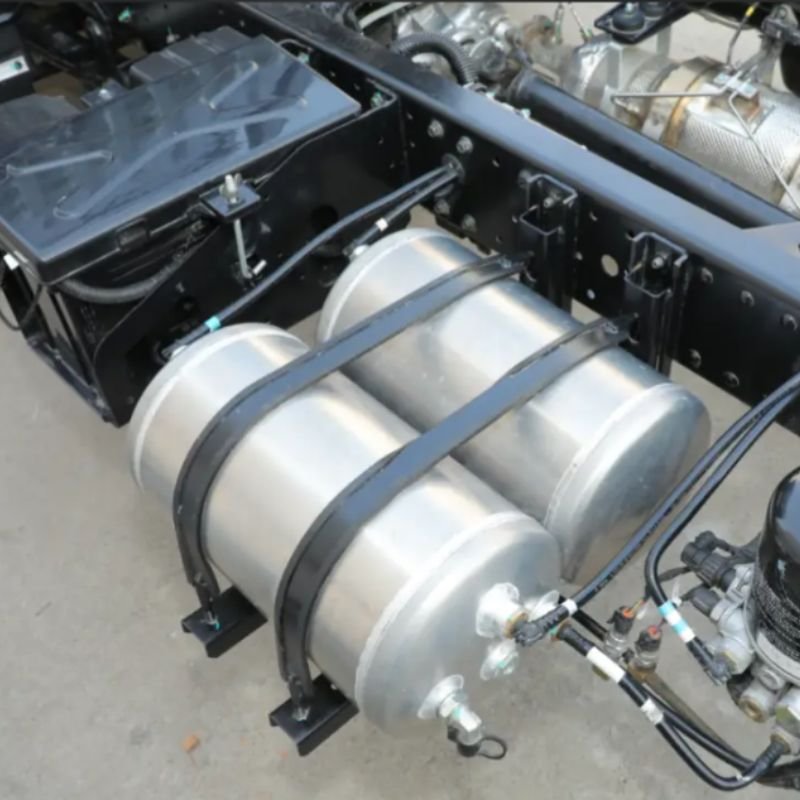
The air tank is a core component of commercial vehicle pneumatic braking systems. It stores compressed air and serves as the power source for various functions, such as braking, clutch assistance, and air horn operation. Its performance and maintenance condition directly impact driving safety and vehicle reliability. To ensure stable system operation, the following precautions should be observed.
I. Daily Inspection and Pressure Monitoring
-Regular Leak Checks: Regularly inspect all air tanks and connecting pipelines for leaks. Special attention should be paid to auxiliary air tanks, as their leaks may not be immediately reflected on the pressure gauge but can lead to issues such as clutch booster pump failure or frequent air pumping after parking.
-Monitor Pressure Changes: Closely observe the readings on the dashboard pressure gauge. During normal driving, if the tank pressure drops too rapidly or drops sharply after braking, it may indicate a leak or abnormal pressure regulation.
-Identify Leak Sources: When troubleshooting leaks, focus on inspecting the air horn pipelines (which are prone to leaks due to their slender design under bumpy conditions) and various pneumatic solenoid valves.
II. Pressure Adjustment and System Modifications
-Do Not Adjust Total Pressure Arbitrarily: The total intake pressure of the air tank system is typically regulated by the Air Processing Unit (APU) and calibrated by engineers at the factory. Do not attempt to adjust it arbitrarily unless modifications have been made or abnormalities are detected.
-Consequences of Lowering Pressure: This may lead to a rapid drop in braking air pressure, weakened braking performance, and abnormal operation of auxiliary equipment (e.g., clutch booster pump, differential lock).
-Consequences of Increasing Pressure: Overly sensitive braking, excessive internal pressure in the air system, and failure of solenoid valves or pipelines may occur, potentially causing gear shifting or clutch assistance malfunctions.
-Temporary Adjustments in Special Cases: If braking pressure is too low, braking performance is poor, and immediate service is unavailable, a slight adjustment can be made temporarily. Locate the vehicle’s Air Processing Unit, use a hex key to turn the intake adjustment screw clockwise by one rotation (typically increasing pressure by approximately 1 bar). After adjustment, reduce the pressure at auxiliary air outlets to prevent overloading the auxiliary air tank.
-Exercise Caution with Modifications: To address the impact of auxiliary air tank leaks on critical functions, some may consider rerouting clutch booster pump lines to the rear brake tank. This practice poses safety risks and is not a fundamental solution. The correct approach is to thoroughly identify the leak source and replace faulty components. Any modifications must prioritize safety and reliability.
III. Troubleshooting and System Knowledge
-Comprehensive Brake Failure Diagnosis: Poor braking performance is not solely a pressure issue. Consider the condition of brake calipers, master cylinders, valve bodies, brake drums, brake pads, and whether the vehicle is overloaded. Even with stable pressure, excessive vehicle weight can reduce braking efficiency.
-Understand Air Supply Sequence and Priorities: Systems equipped with a four-circuit protection valve typically follow this air supply sequence: rear axle brake tank > front axle and control circuit tank > auxiliary equipment tank > parking brake tank. This design ensures priority air supply to the braking system. Typically, the clutch booster pump operates only when the gauge pressure exceeds 6 bar, and the parking brake is released last.
-Clarify Functions of Each Tank: The front and rear axle brake tanks in the main vehicle have thicker pipelines, ensuring more reliable air pressure output. The auxiliary tank supplies air to components such as the air horn, clutch booster pump, transmission shift cylinder, exhaust butterfly valve, and cab air springs. Another tank is dedicated to trailer braking and parking brake systems.
IV. Summary of Maintenance Key Points
- Adjustments to the air tank system are specialized operations and should be performed under the guidance of service technicians.
- Daily maintenance should focus on leak inspection and pressure monitoring rather than proactive adjustments.
- Any modifications involving the air system must be evaluated for safety risks. Standard repair methods, such as troubleshooting and replacing faulty components, should be prioritized.
- Develop a fundamental understanding of the working principles and priorities of the vehicle’s air system to accurately identify the source of faults.